
REVIEW · RED ROCK CANYON TOURS
Red Rock Canyon Tour Self-Guided Drive Experience
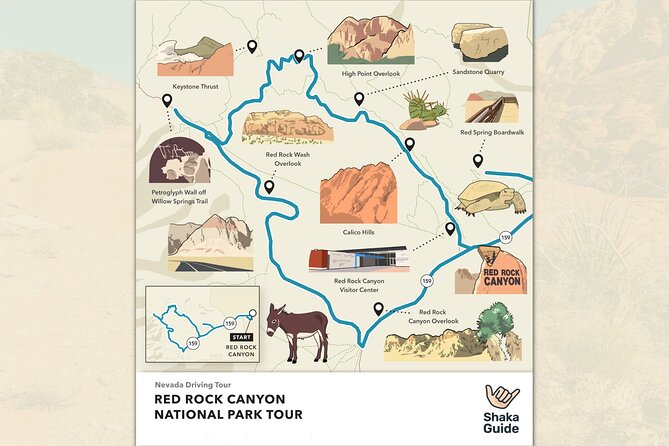
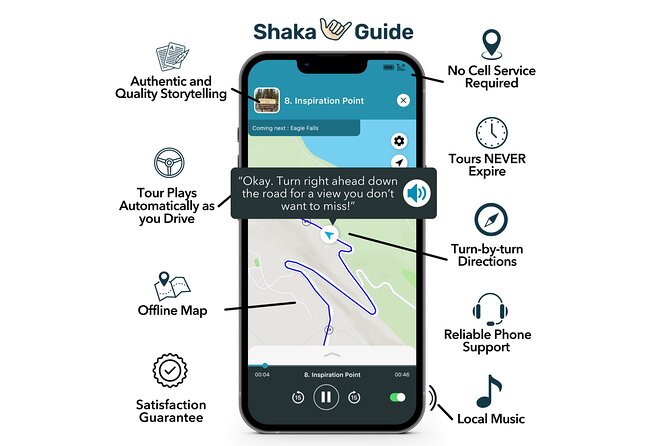
Your GPS drive turns geology into a story. This Red Rock Canyon self-guided drive uses GPS-activated narration and music, plus an offline map, so you can focus on the scenery without hunting for info.
I love how the audio plays automatically as you drive, then you can pause and hop out for photos or hikes. I also like that the price is per vehicle/group (up to 15 people), not per person, so the math stays friendly. One catch to plan around: the loop is one-way, and the Visitor Center is only on the opening stretch, so arriving too late means you miss the running-water restrooms and water filling station.
In This Review
- Key highlights I think you’ll care about
- First: what this self-guided Red Rock Canyon drive really gives you
- Getting set up in Las Vegas: Summerlin start and app basics
- One-way loop reality: plan to hit the Visitor Center first
- Small drawback to know ahead
- The Scenic Drive segment: your main event (and the reservation check)
- Calico I and Calico Hills: red rock color you can feel in your camera
- Stop 3: Calico I
- Stop 4: Calico Hills
- Sandstone Quarry Overlook and the start of Calico Tanks Trail
- Quick-hit overlooks: High Point and White Rock Trailhead
- Stop 6: High Point Overlook
- Stop 7: White Rock Trailhead
- Willow Spring and Lost Creek Canyon: petroglyphs, bighorn sheep, and a seasonal waterfall maybe
- Stop 8: Willow Spring
- Stop 9: Lost Creek Canyon
- Ice Box Canyon and the “choose your intensity” moments
- Stop 10: Ice Box Canyon
- Stop 11: Red Rock Canyon Overlook
- Stop 12: Pine Creek Canyon
- Stop 13: Oak Creek Canyon
- The finishing highlights: the best overlook feel, then horses and picnic views
- Stop 14: Red Rock Canyon Overlook (the one to prioritize)
- Stop 15: Cowboy Trail Rides
- Stop 16: Red Spring Picnic Area
- Timing that fits a 5–6 hour day (without rushing)
- Cost and value: $10.39 per group, plus the entrance fees you should budget
- Who should book this self-guided audio drive
- A note for audiences who want a fully adult, deep lecture style
- Should you book this Red Rock Canyon self-guided drive?
- FAQ
- What’s the duration of the Red Rock Canyon self-guided drive?
- Do I need to buy entrance tickets for Red Rock Canyon?
- Does the tour work offline?
- Is the audio guided while I drive, or do I have to press buttons?
- How many people can go for one booking?
- Do I need a reservation for the Scenic Drive?
Key highlights I think you’ll care about
- One tour per vehicle (up to 15) keeps costs low for groups
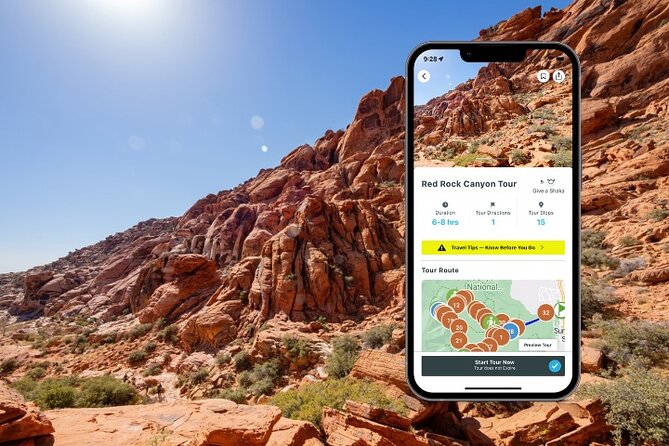
- Offline navigation and audio means no cell signal stress
- Visitor Center at the start offers running-water restrooms and maps
- Short hikes with big payoffs like the Petroglyph Wall Trail
- Top overlooks are timed for quick photo stops without rushing hikes
- You can stop and resume so the drive fits your pace
Closer to town: more Red Rock Canyon runs

First: what this self-guided Red Rock Canyon drive really gives you

This isn’t a “bus tour with forced timing” kind of day. It’s a self-guided audio route built around the Red Rock Canyon Scenic Drive experience, where the narration and directions line up with where you are. That matters because Red Rock Canyon is full of details that are easier to notice when someone points out what you’re looking at.
You’ll also get freedom without guesswork. The GPS turn-by-turn guidance helps you stay on the loop and hit the classic viewpoints in a logical order. And because the tour includes offline access, you can plan for a day outside reliable data coverage.
Getting set up in Las Vegas: Summerlin start and app basics
The tour starts in Summerlin, Las Vegas, and ends back at the same meeting point. That’s convenient because you’re not juggling a drop-off somewhere remote.
Before you go, the key is simple:
- Download the tour using strong Wi-Fi (you’ll need this for offline use later).
- In the Shaka Guide app, you’ll redeem a code you get after booking, then launch the tour from the starting point.
- Once you start the drive, the audio narration and music are designed to play automatically as you go.
If you’re the type who likes to run errands and then escape fast, this is a nice setup. You’re not waiting for a guide to arrive, and you don’t have to keep checking your phone screen while driving.
One-way loop reality: plan to hit the Visitor Center first
Red Rock Canyon Scenic Drive has a one-way loop, which changes how you should think about timing. The Visitor Center is only passed at the beginning, so it’s your one shot for the on-site amenities and orientation.
Stop 1 is worth treating like your trailhead basecamp:
- Running-water restrooms and a water filling station
- An information booth with trail maps
- A gift shop and outdoor exhibits worth a walk-through
- A chance to see live desert tortoises
Even if you don’t plan to spend long, I’d still recommend arriving with enough daylight buffer to handle this stop calmly. If you miss it, you don’t get a second chance on the road.
One more to line up against this Las Vegas booking:
- Red Rock Canyon Self-Guided Electric Bike Tour★ 5.0 · 783 reviews
- Las Vegas: Guided Las Vegas Desert ATV Tour★ 4.6 · 677 reviews
- Las Vegas Downtown & Fremont Street – Guided Walking Tour★ 5.0 · 636 reviews
- Las Vegas: Valley of Fire Guided Hike with Drinks and Snacks★ 4.9 · 548 reviews
- Las Vegas: Grand Canyon National Park South Rim Guided Tour★ 4.4 · 531 reviews
- Small Group Guided Colorado River & Emerald Cave Kayak Tour★ 5.0 · 500 reviews
Small drawback to know ahead
Because it’s only at the start, you’ll want to avoid a late entry. Parking can be busy, and you don’t want your day turned into a scramble for facilities.
The Scenic Drive segment: your main event (and the reservation check)
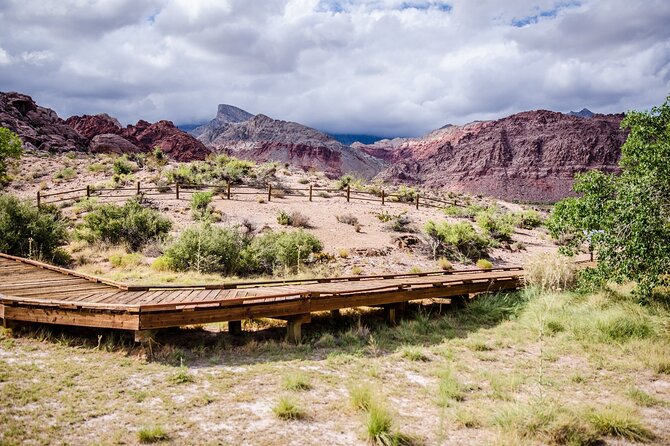
Stop 2 is the heart of the day: the Red Rock Canyon National Conservation Area Scenic Drive. This is where “most of the worth-seeing” happens, and it includes the Visitor Center area at the beginning.
Two practical points:
- Much of the year, you may need a reservation for the Scenic Drive. If that applies to your dates, you’ll want to sort it out ahead of time.
- The tour’s job is to guide you through the most meaningful viewpoints so you’re not bouncing between pull-offs randomly.
Admission here is listed as free, but your overall budget still depends on the entrance fees for Red Rock Canyon and any parking fees (those are not included).
Calico I and Calico Hills: red rock color you can feel in your camera
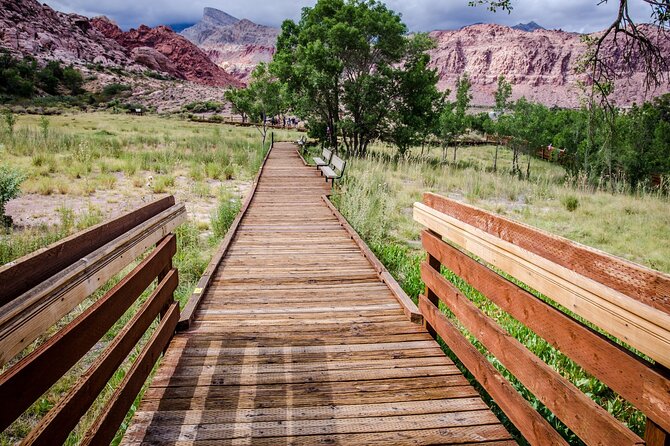
Stops 3 and 4 are where the canyon starts showing off hard.
Stop 3: Calico I
This is the “don’t just look, step on the rock” stop. You can park and take photos quickly, but the landscape invites short wandering too. The Calico I trail network includes routes that can run 2 to 6 miles, depending on how far you connect start and end points.
Why I like it for a self-guided day: you can sample the trail without committing to a long hike. Even a partial walk gives you that up-close view of rock shapes that feels different than looking from a viewpoint.
Stop 4: Calico Hills
This one is built for photos. If you find a parking spot, you can also access part of the same broader Calico Hills trail system from this angle, with different vantage points and scenery variety.
Time reality: this is short. Plan to make quick decisions: photo first, then decide if you want a mini-walk.
Sandstone Quarry Overlook and the start of Calico Tanks Trail
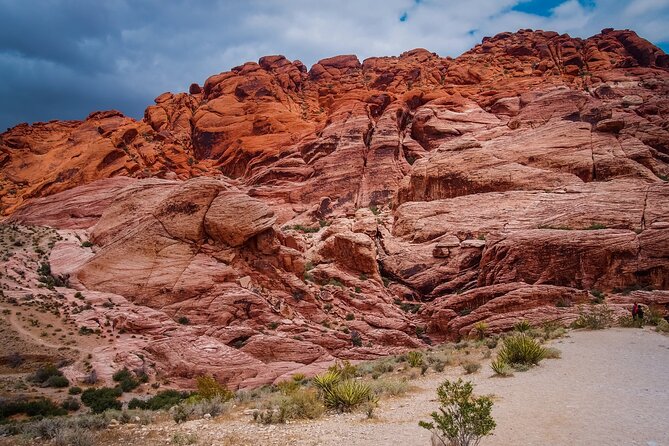
Stop 5 adds two things: geology texture and the beginning of a popular hike.
At the Sandstone Quarry Overlook, you’re looking at leftover evidence of old quarry activity—cuts in the sandstone and slabs still on-site. If you like noticing how nature and industry have both shaped the scene, this stop gives you that context.
Two practical tips:
- You might have to circle to find parking. It’s popular for a reason.
- The Calico Tanks Trail begins here, and this area is a common jumping-off point for people doing the longer hike.
Also keep an eye upward. Rock climbers can be visible high on the walls. They’re far enough away that they can look like tiny marks until you lock your focus.
Quick-hit overlooks: High Point and White Rock Trailhead
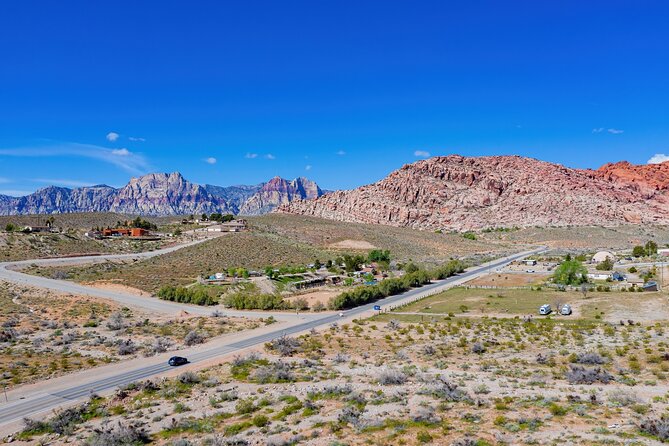
After the trail-focused stops, the tour pivots to viewpoints you can enjoy in minutes.
Stop 6: High Point Overlook
A quick pull-in and look. This is where the route rewards you for staying patient and letting the narration do its job—your attention shifts from “where am I supposed to go” to “look at that.”
Stop 7: White Rock Trailhead
This is one of the best “get out and turn in a full circle” moments on the drive. It’s also at 4,771 feet above sea level, the highest elevation point noted for Red Rock Canyon on this route.
If you want a payoff without committing to a hike, this is the stop. Get your photos, breathe, then move on.
Willow Spring and Lost Creek Canyon: petroglyphs, bighorn sheep, and a seasonal waterfall maybe
These are the stops where the day starts to feel more like a nature outing than a scenic drive.
Stop 8: Willow Spring
From the Scenic Drive, you’ll take a short turnoff to a picnic-area setting with two highly recommended hikes.
1) Petroglyph Wall Trail
- About 0.15 miles out-and-back
- Roughly 30 minutes round trip
- Features ancient art on a cliff wall dating back over 800 years
This is a great “leg stretch” hike. Short enough for families and casual walkers, but it gives you a cultural layer that goes beyond just rocks.
2) Willow Springs Loop
- About 1.5 miles round trip
- Rated easy
- Often best done partly along the route that runs parallel to the parking lot
This loop is also where you might spot bighorn sheep above on ledges. They blend in, so keep your eyes scanning upward and along the rocky edges.
You’ll also pass the largest ancient agave roasting pits in this area, which is a fascinating detail if you like learning what ancient people were doing here.
If you packed lunch, this is the moment to eat while the canyon does the entertaining.
Stop 9: Lost Creek Canyon
In the same general area as Willow Spring, you get another vantage point for spotting bighorn sheep.
There’s also a popular hike here: Children’s Discovery Trail.
- Rated easy
- Some rocky terrain and a boardwalk section
- Includes a hidden seasonal waterfall that usually flows between December and April
If your timing is outside that window, you may not catch the waterfall—but the trail format still gives you variety, plus desert plant life.
Ice Box Canyon and the “choose your intensity” moments
Not every stop is built for everyone to hike the full way.
Stop 10: Ice Box Canyon
This area is popular for birding and for more advanced hikers. The trailhead from here is described as difficult and strenuous.
Here’s the practical move for a self-guided day: you can treat it as a pull-in photo stop and enjoy the scene without committing to the hardest route. If you want the workout, you already have a clear clue about what to expect.
Stop 11: Red Rock Canyon Overlook
Short, serene, and easy. You can park, look out, and let the wind and birds fill the time. Even specific bird spotting is part of the narration, including the western tanager in the Joshua Trees area.
Stop 12: Pine Creek Canyon
This is another viewpoint built for open desert and canyon-wall views, plus different plant life. There’s also a moderate hike option from here that goes past an old homestead site and into a meadow.
If you arrive later, you might notice silhouette effects from the sun behind the mountains. That’s not something you can force, but planning your day with late light in mind can make the colors feel very different.
Stop 13: Oak Creek Canyon
Oak Creek Canyon requires a short drive down a gravel road. The good news: you don’t need a special vehicle. Regular cars can handle it if you drive slowly and carefully.
This is also one of the areas where mule deer may appear close to the road—so keep your eyes out instead of only watching the trail in front of you.
The finishing highlights: the best overlook feel, then horses and picnic views
When you reach the last stretch of the route, the stops start stacking up with “quick, iconic, and worth it” energy.
Stop 14: Red Rock Canyon Overlook (the one to prioritize)
This is arguably the top overlook on the route. Park at the lot and walk the paved path that starts at the helipad at the far end of the parking area.
As you walk:
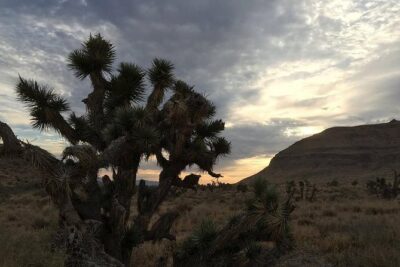
- you pass Joshua Trees
- you reach benches at the tip overlook
- you get views of many of the big mountains you drove past during the loop
If you like to eat and take in a view, this stop is also set up for picnics.
Stop 15: Cowboy Trail Rides
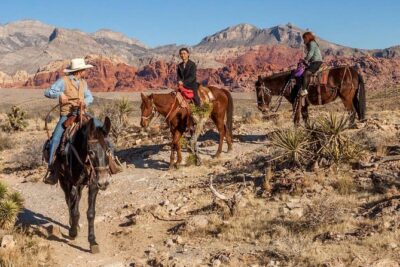
This is a fun contrast: a place to see horses and mules in the context of the canyon. You might also see Jackson the Red Rock Burro, depending on whether he’s home or out on a trail ride.
The Fossil Ridge Trail begins here too, which is a nice option if you want to keep walking before wrapping up.
Stop 16: Red Spring Picnic Area
The final stop is a picnic area with a stunning view, and you get about one hour here. This is where you can slow down, sort photos, and decide if you want a final short walk before heading back toward Las Vegas.
Timing that fits a 5–6 hour day (without rushing)
The tour is listed as about 5 to 6 hours. That range makes sense because you’re choosing your hiking intensity rather than being herded through fixed blocks.
A simple way to think about your day:
- Plan for a proper Visitor Center start (restrooms, maps, exhibits).
- Spend time at Calico and Sandstone Quarry if you want at least a partial hike.
- Treat Willow Spring as your “story stop” (petroglyphs and bighorn sheep potential).
- Save your energy for the best overlook stop near the end, then relax at Red Spring.
If you like quick wins, you can keep many stops to 5–20 minutes. If you like wandering, the loop can stretch toward the top end—especially if you do more than part of the Calico Tanks Trail or Willow Springs Loop.
Cost and value: $10.39 per group, plus the entrance fees you should budget
The headline price is $10.39 per group (up to 15 people). That’s unusual in a good way. It means the app and narration cost stays flat no matter how many people pile into one vehicle.
But the tour doesn’t include everything:
- Entrance fees: $15.00 per person are not included
- Parking fees are not included
- Meals and refreshments aren’t included
So the real value equation is this:
- If you’re a small group, the per-vehicle tour fee is a bargain, and your main cost becomes the park entrance.
- If you’re a big group (up to 15 in one vehicle), the tour fee becomes almost trivial compared to per-person entrance costs.
If you’re comparing options, price alone isn’t the story here. The GPS-guided narration and offline routing are what justify the fee. They help you get the best “story behind the rocks” without needing a guide in the car.
Who should book this self-guided audio drive
This works best for:
- People who want hands-free guidance and don’t want to plan every viewpoint
- Folks who like to stop and go without feeling late
- Anyone interested in geology, desert history cues, or simply getting better at noticing what’s in front of you
It’s also a good match if you’re traveling with a mixed group of walkers and photo-takers, because you can scale hiking effort stop by stop.
A note for audiences who want a fully adult, deep lecture style
The narration is designed to be friendly and accessible. That’s a win for casual learners. If you’re looking for extremely technical, speaker-like depth, you might find it more light than academic based on how the style has been received.
Should you book this Red Rock Canyon self-guided drive?
If you want a flexible, cost-smart way to experience the Scenic Drive without turning the day into route research, I’d book it. The offline map, GPS-activated audio, and ability to pause and restart are exactly the kind of tools that make this park feel easy to enjoy.
My decision tip: prioritize your schedule around the one-way loop. Get to the Visitor Center early so you can use the restrooms and fill water, then enjoy the viewpoints and hikes at your pace. If you can handle that planning detail, this is a strong way to spend a full half-day in one of the best places near Las Vegas for desert scenery and smart short walks.
FAQ
What’s the duration of the Red Rock Canyon self-guided drive?
It’s listed as about 5 to 6 hours.
Do I need to buy entrance tickets for Red Rock Canyon?
Entrance fees of $15.00 per person are not included. Parking fees also aren’t included.
Does the tour work offline?
Yes. You get an offline map and the tour is designed to work without continuous wifi or data. You should download it ahead of time using strong Wi-Fi.
Is the audio guided while I drive, or do I have to press buttons?
The audio narration is designed to play automatically as you drive, with GPS-activated directions and music. You can also start, pause, and resume.
How many people can go for one booking?
The price is per group (up to 15) for one vehicle, and it’s stated as one tour per vehicle.
Do I need a reservation for the Scenic Drive?
Much of the year, a reservation is required for the Scenic Drive, so you should plan for that if your travel dates fall in the reservation season.
More Tours in Las Vegas
- Half-Day Mojave Desert ATV Tour from Las Vegas
★ 5.0 · 7,350 reviews - Grand Canyon West Bus Tour with Hoover Dam and Optional Skywalk
★ 4.0 · 7,224 reviews - Ultimate VIP Hoover Dam Tour from Las Vegas with Lunch
★ 5.0 · 6,782 reviews - Lower Antelope Canyon and Horseshoe Bend Day Tour with Lunch
★ 5.0 · 6,764 reviews - Las Vegas Helicopter Night Strip Flight Tour with Optional Dinner
★ 4.5 · 5,693 reviews - Half-Day Emerald Cave Kayak Tour with Optional Hotel Pickup
★ 5.0 · 4,978 reviews
More Tour Reviews in Las Vegas
- Grand Canyon West, Hoover Dam Stop and Optional Lunch and Skywalk
★ 5.0 · 19,535 reviews - Grand Canyon West, Hoover Dam Stop, Breakfast, Lunch & Skywalk
★ 5.0 · 12,194 reviews - Half-Day Mojave Desert ATV Tour from Las Vegas
★ 5.0 · 7,350 reviews - Grand Canyon West Bus Tour with Hoover Dam and Optional Skywalk
★ 4.0 · 7,224 reviews - Ultimate VIP Hoover Dam Tour from Las Vegas with Lunch
★ 5.0 · 6,782 reviews - Lower Antelope Canyon and Horseshoe Bend Day Tour with Lunch
★ 5.0 · 6,764 reviews
Red Rock Canyon, A Few More
- Scooter Tours of Red Rock Canyon
★ 5.0 · 2,174 reviews - Red Rock Canyon eBike Half-Day Tour
★ 5.0 · 1,870 reviews - Red Rock Canyon Sunset Horseback Ride and Barbeque Dinner
★ 5.0 · 1,305 reviews - Award Winning Red Rock Canyon Tours
★ 5.0 · 970 reviews - 2-Hour Horseback Riding through Red Rock Canyon
★ 5.0 · 838 reviews - Red Rock Canyon Self-Guided Electric Bike Tour
★ 5.0 · 783 reviews
Fresh off the Strip: new Las Vegas reviews





Red Rock Canyon Tours, compared.
 ★ 5.0Scooter Tours of Red Rock CanyonFrom $1352,174 reviews
 ★ 5.0Red Rock Canyon eBike Half-Day TourFrom $1371,870 reviews
 ★ 5.0Red Rock Canyon Sunset Horseback Ride and Barbeque DinnerFrom $1991,305 reviews
 ★ 5.0Award Winning Red Rock Canyon ToursFrom $85970 reviews
 ★ 5.02-Hour Horseback Riding through Red Rock CanyonFrom $149838 reviews
 ★ 5.0Red Rock Canyon Self-Guided Electric Bike TourFrom $129783 reviews
 ★ 5.0Scooter Car Tour of Red Rock Canyon with Transport from Las VegasFrom $350779 reviews
 ★ 5.0Red Rock Canyon Hike with Transport from Las VegasFrom $129750 reviews
Browse the lists this tour appears in